
A few years ago, ESG investing was treated as one of the fastest growing trends in finance. Fund managers launched sustainable ETFs, retirement plans added ESG options, and investors started asking whether their portfolios could reflect climate risk, labor standards, board quality, and corporate ethics.
Then the conversation became more complicated.
Some ESG funds underperformed when fossil fuel stocks rallied. Regulators started questioning greenwashing. Certain U.S. states pushed back against ESG policies. At the same time, climate risk, corporate governance failures, supply chain scandals, and labor disputes continued to affect real company values.
That is why ESG investing is not just about “doing good.” At its best, it is a way to evaluate companies using financial and nonfinancial risks that may affect long term performance.
ESG stands for Environmental, Social, and Governance. ESG investing is the practice of selecting investments based on how companies manage environmental risks, social responsibilities, and governance standards. Investor.gov describes ESG investing as investing in companies based on their commitment to one or more ESG factors, and notes that it is often also called sustainable investing, socially responsible investing, or impact investing.
Key Takeaways
- ESG investing evaluates companies based on environmental, social, and governance factors.
- ESG does not automatically mean low risk, high return, or “ethical” in every investor’s view.
- ESG funds can use different methods, including exclusions, best in class selection, ESG integration, shareholder engagement, and impact focused investing.
- Costs vary widely. Some ESG ETFs charge expense ratios below 0.10%, while active ESG funds, robo advisors, and private market impact strategies can cost much more.
- Greenwashing is a real risk. Investors should read the fund prospectus, holdings, screens, voting record, and expense ratio before investing.
- ESG investing is best for investors who want to consider sustainability risks alongside financial returns.
- Investors who want the cheapest and broadest market exposure may prefer traditional index funds.
What Is ESG Investing?
ESG investing is an investment approach that considers three broad categories.
Environmental factors look at how a company affects and responds to the physical environment. This can include carbon emissions, energy use, water management, pollution, waste, biodiversity, climate transition plans, and exposure to extreme weather.
Social factors look at how a company treats people. This can include employee safety, wages, labor relations, customer privacy, product safety, supply chain practices, human rights, community impact, and diversity policies.
Governance factors look at how a company is controlled and managed. This includes board independence, executive pay, shareholder rights, audit quality, corruption risk, political spending, tax transparency, and whether management acts in shareholders’ interests.
A strong ESG investor is not asking only, “Is this company morally good?”
A better question is:
Does this company manage environmental, social, and governance risks in a way that protects long term value?
For example, a mining company with poor safety practices may face lawsuits, shutdowns, fines, and higher insurance costs. A technology company with weak data privacy controls may face regulatory penalties and customer distrust. A company with an overpaid and poorly supervised executive team may destroy shareholder value through bad acquisitions or accounting problems.
ESG investing tries to catch these risks before they show up as losses.
How ESG Investing Works
ESG investing can be done in several ways. This is where many beginners get confused because two funds with “ESG” in the name may invest very differently.
Negative Screening
Negative screening removes certain industries or companies from a portfolio.
Common exclusions include:
- Tobacco
- Civilian firearms
- Controversial weapons
- Thermal coal
- Oil sands
- Gambling
- Adult entertainment
- Severe controversies
For example, the iShares ESG Aware MSCI USA ETF applies business involvement screens for civilian firearms, controversial weapons, tobacco, thermal coal, and oil sands, while seeking broad exposure to large and mid cap U.S. companies with positive ESG characteristics.
Negative screening is easy to understand. The tradeoff is that exclusions can reduce diversification and may cause the fund to perform differently from the broader market.
Best in Class Selection
Best in class ESG investing does not remove entire sectors. Instead, it selects companies with stronger ESG ratings relative to peers in the same industry.
For example, an ESG fund may still own energy, mining, or utility stocks, but prefer companies with stronger emissions reporting, better safety records, more credible transition plans, or better governance.
This approach is more flexible than simple exclusion. It also creates debate because some investors do not want exposure to certain industries at all.
ESG Integration
ESG integration means including ESG data in standard financial analysis.
An analyst may review revenue growth, margins, debt, cash flow, valuation, and also ESG issues that may affect future performance.
For example:
- A manufacturer with high energy costs may benefit from efficiency investments.
- A bank with weak compliance controls may face fines and reputational damage.
- A retailer with supply chain labor issues may face consumer backlash.
- A utility with outdated coal assets may face higher capital spending and regulatory risk.
ESG integration is often used by large institutional investors because it treats ESG as part of risk management rather than a separate moral screen.
Shareholder Engagement
Some ESG investors buy shares and then use ownership rights to push companies toward better disclosure or behavior.
This may involve voting on shareholder proposals, meeting with management, or supporting board changes.
Engagement can be powerful, but it takes time. It also requires investors to check whether a fund manager’s voting record matches its marketing language.
Impact Investing
Impact investing goes further than ESG screening.
The goal is to generate financial returns and measurable positive outcomes, such as affordable housing, renewable energy capacity, financial inclusion, clean water, or healthcare access.
Impact investing is often more concentrated and may involve private funds, community development finance, green bonds, or thematic ETFs. It can be useful, but investors should be careful about liquidity, fees, and proof of impact.
Why ESG Investing Matters to Your Wallet

ESG investing affects your money in three main ways: risk, return, and values alignment.
ESG Can Help Identify Business Risk
ESG issues can become financial issues.
A company with poor governance may suffer accounting scandals. A company with weak safety controls may face fines and production stoppages. A company exposed to climate events may face property damage, insurance costs, or supply disruptions.
ESG investing is not charity. In many cases, it is risk analysis.
ESG Can Change Portfolio Exposure
ESG funds often hold less energy, tobacco, weapons, or controversial industry exposure than traditional funds. They may hold more technology, healthcare, financial services, or consumer companies depending on the index method.
That can help or hurt performance.
For example, ESG funds that avoided fossil fuel stocks generally struggled during periods when oil and gas stocks outperformed. When technology and growth stocks lead the market, some ESG funds may benefit because they often have larger technology exposure.
This is why investors should not assume ESG will always outperform or underperform. Portfolio construction matters.
ESG Can Affect Fees
Low cost ESG ETFs are now available, but ESG investing is not always cheap.
A 0.09% expense ratio costs $9 per year on a $10,000 investment. A 0.75% expense ratio costs $75 per year. Over decades, that gap can become meaningful because fees reduce compounding.
Investors should compare an ESG fund’s cost with a similar non ESG index fund before investing.
ESG Investing Market Facts
The ESG market has grown, but the growth story is no longer simple.
US SIF reported that the U.S. sustainable investment market was $6.6 trillion in its 2025 trends analysis, compared with $6.5 trillion in 2024, while the total U.S. market size was recorded at $61.7 trillion.
Morningstar reported that global sustainable fund flows turned positive in the first quarter of 2026, with an estimated $3.5 billion in net inflows after $27 billion in outflows in the fourth quarter of 2025. The rebound was driven mainly by Europe, where sustainable funds attracted more than $9 billion in net new money.
This matters because ESG demand is not moving in one straight line. Europe remains a major center for sustainable fund regulation and demand, while the U.S. market has faced stronger political and performance pressure.
ESG Rules and Greenwashing Risk
Greenwashing happens when an investment product sounds more sustainable than it really is.
Regulators have become more active because fund names can shape investor expectations.
The SEC adopted amendments to the Investment Company Act “Names Rule” in 2023. The rule requires more funds to adopt an 80% investment policy when their names suggest a focus on certain investment types or characteristics, including names using environmental, social, or governance factors. Funds must also review compliance with the 80% policy at least quarterly.
In Europe, ESMA published guidelines on fund names using ESG or sustainability related terms, aimed at linking fund names more clearly with investment strategy and sustainability related claims.
The SEC also adopted climate disclosure rules in 2024, but in March 2025 the Commission voted to end its defense of those rules in court. That means U.S. climate disclosure policy has been politically and legally unstable, which investors should understand when comparing U.S. and European ESG disclosures.
The practical lesson is simple: do not buy an ESG fund based only on the name.
Read the holdings, screens, methodology, fees, and stewardship record.
Exact ESG Investing Cost Structure
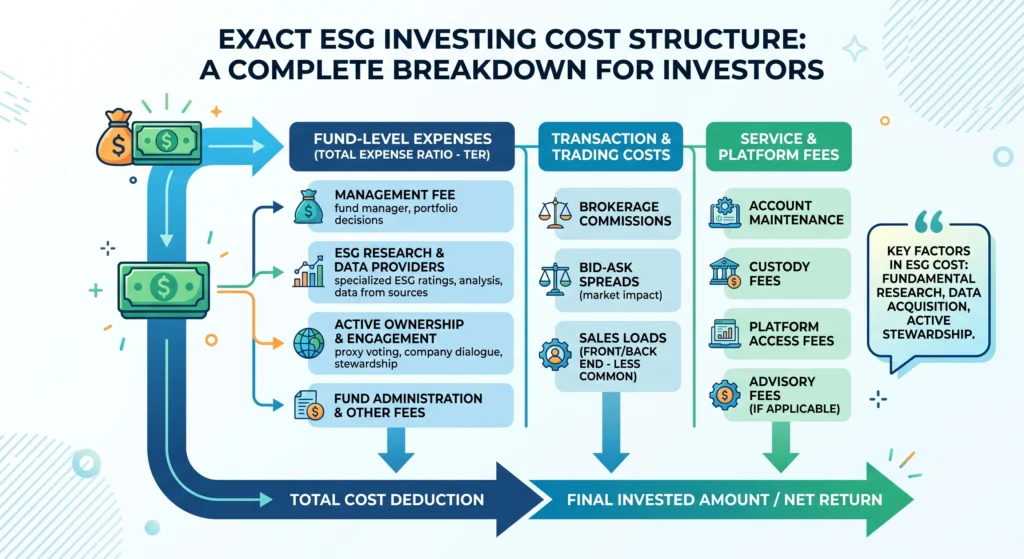
ESG investing has no single price. The total cost depends on the investment product, broker, advisor, fund expense ratio, taxes, trading spread, and account type.
The table below shows the main cost layers.
| Cost Type | Typical Cost | How It Affects You |
|---|---|---|
| ETF expense ratio | About 0.03% to 0.25% for many large passive ETFs | Deducted from fund assets each year |
| Active ESG mutual fund expense ratio | Often higher than passive ETFs | Higher fees reduce long term compounding |
| Robo advisor fee | Wealthfront lists 0.25% annually for its automated investing account | Added on top of underlying fund expenses |
| Human financial advisor | Often 0.50% to 1.00% or more annually, depending on advisor and account size | May include planning, tax strategy, and portfolio management |
| Brokerage commission | Often $0 for U.S. listed ETFs at major online brokers | Check your platform, especially outside the U.S. |
| Bid ask spread | Varies by fund liquidity | A hidden trading cost when buying or selling |
| Taxes | Depends on account type and country | Dividends and capital gains may be taxable |
| SIPC protection | No direct investor fee | SIPC protects eligible brokerage customers up to $500,000, but does not protect against market losses |
Real ETF Cost Examples
| Fund | Strategy | Expense Ratio | Other Useful Details |
|---|---|---|---|
| Vanguard ESG U.S. Stock ETF, ESGV | Broad U.S. ESG screened equity ETF | 0.09% | Vanguard lists a 30 day SEC yield of 0.85% as of June 30, 2026 |
| iShares ESG Aware MSCI USA ETF, ESGU | Large and mid cap U.S. ESG aware ETF | 0.15% | BlackRock listed net assets of about $17.8 billion and 278 holdings as of July 7, 2026 |
| iShares ESG MSCI KLD 400 ETF, DSI | U.S. all cap ESG ETF with broader controversy screens | 0.25% | BlackRock listed about $5.3 billion in fund net assets and 403 holdings in early July 2026 |
| Vanguard Total Stock Market ETF, VTI | Broad U.S. stock market ETF, not ESG specific | 0.03% | Vanguard listed a 0.03% expense ratio as of April 28, 2026 |
On a $10,000 investment, a 0.09% expense ratio costs about $9 per year. A 0.25% expense ratio costs about $25 per year. A 1.00% advisory fee costs about $100 per year before fund expenses.
The dollar amount looks small in year one. Over 20 or 30 years, the difference can become much larger because fees reduce the amount left to compound.
ESG Investing vs Similar Strategies
ESG is often confused with socially responsible investing, impact investing, climate investing, and traditional index investing. They overlap, but they are not the same.
| Strategy | Main Goal | Typical Holdings | Cost Profile | Best For |
|---|---|---|---|---|
| ESG Investing | Consider environmental, social, and governance risks alongside return | Broad stocks or bonds with ESG screens or ratings | Low to moderate if using ETFs | Investors who want sustainability risk considered without leaving public markets |
| Socially Responsible Investing | Avoid companies that conflict with specific values | Often excludes tobacco, weapons, gambling, alcohol, fossil fuels, or other categories | Varies by fund | Investors with clear moral or religious exclusions |
| Impact Investing | Seek measurable positive outcomes plus financial return | Green bonds, private funds, community finance, renewable energy, housing, healthcare | Can be higher, especially in private markets | Investors who want measurable social or environmental outcomes |
| Climate Thematic Investing | Focus on climate transition opportunities | Renewable energy, batteries, clean tech, efficiency, climate infrastructure | Can be moderate to high | Investors willing to accept sector concentration |
| Traditional Index Investing | Track the broad market at low cost | Broad market stocks and bonds without ESG screens | Often very low | Investors who prioritize low cost, diversification, and tracking the market |
Who Wins in Each Scenario?
Traditional index investing usually wins on cost and diversification. A broad market ETF such as VTI has a lower expense ratio than many ESG funds and includes more companies. That can make it harder to beat as a long term core holding.
ESG investing wins when an investor wants a broad portfolio but also wants to reduce exposure to certain risks or industries. It is usually less restrictive than values based investing and less concentrated than climate themed funds.
Socially responsible investing wins when the investor has specific exclusions that matter more than benchmark tracking. For example, an investor may not want exposure to tobacco, firearms, alcohol, or gambling regardless of expected returns.
Impact investing wins when the investor wants measurable outcomes, not just screened public stocks. The tradeoff is that costs, liquidity risk, and due diligence needs may be higher.
Climate thematic investing wins when the investor wants focused exposure to transition industries. It can also be volatile because it depends heavily on policy, interest rates, commodity prices, and technology adoption.
How to Evaluate an ESG Fund Before Investing

Do not stop at the fund name. Use a practical checklist.
1. Read the Fund Objective
Ask what the fund is trying to do.
Is it trying to match the risk and return of a broad market index while improving ESG exposure? Is it trying to avoid fossil fuels? Is it trying to invest in climate solutions? Is it trying to influence companies through engagement?
These are different goals.
2. Check the Expense Ratio
A 0.25% ETF may be reasonable for a specific ESG strategy. A 1.00% fund needs a stronger reason to justify the cost.
Compare the fund with a low cost non ESG index fund and a cheaper ESG alternative.
3. Review the Holdings
Look at the top 10 holdings and sector allocation.
Some investors are surprised to see large technology, bank, or energy related holdings inside ESG funds. That does not always mean the fund is doing something wrong. It means the fund’s method may be based on relative ESG scores rather than absolute exclusions.
4. Understand the Screens
Does the fund exclude fossil fuels, or only thermal coal and oil sands? Does it exclude weapons, or only controversial weapons? Does it exclude companies with severe controversies?
The details matter.
5. Check Tracking Difference
If the fund aims to behave like a broad market index, compare performance with the benchmark.
A fund with heavy exclusions may perform very differently from the market. That may be acceptable, but investors should know it in advance.
6. Review Voting and Engagement
If the fund manager claims to influence companies, look at proxy voting and stewardship reports.
Engagement claims are weaker if the manager rarely supports sustainability related shareholder proposals or does not disclose outcomes clearly.
Risks of ESG Investing

ESG investing has benefits, but it also carries real risks.
Greenwashing Risk
Some funds use ESG language without applying strong ESG standards. Regulation is improving, but investors still need to inspect the strategy.
Concentration Risk
A fund that excludes several sectors may become concentrated in technology or other industries. This can help when those sectors perform well and hurt when they underperform.
Data Quality Risk
ESG ratings can differ between providers. One rating agency may score a company highly because of strong disclosure. Another may penalize the same company because of emissions, supply chain risk, or governance concerns.
Political and Regulatory Risk
ESG has become politically sensitive in the U.S. Some institutions now use terms such as sustainability, stewardship, transition risk, or responsible investing instead of ESG.
Performance Risk
ESG funds can outperform or underperform traditional funds depending on sector exposure, market cycle, fees, and strategy design. ESG is not a guaranteed return enhancer.
ESG Investing and Investor Protection
ESG funds are investments, not bank deposits.
If you hold ESG ETFs or mutual funds in a brokerage account, SIPC protection may apply if the brokerage firm fails and customer assets are missing. But SIPC does not protect against declines in the market value of your securities.
That means an ESG ETF can lose value like any other stock or bond fund.
You should also understand that FDIC insurance applies to eligible bank deposits, not to market losses in ETFs, mutual funds, or stocks.
Final Strategic Verdict
ESG investing is a useful strategy for investors who want to consider sustainability risks, corporate behavior, and governance quality alongside traditional financial metrics.
It is best for long term investors who still care about diversification, fees, valuation, and risk management. A low cost ESG ETF can work as a core holding for someone who wants broad market exposure with ESG screens. A more focused impact or climate fund may work as a smaller satellite position for investors who accept higher concentration risk.
ESG investing is not ideal for investors who want the lowest possible fees, the broadest possible market exposure, or a portfolio that perfectly matches every personal value. It is also not ideal for anyone who assumes “ESG” automatically means safe, ethical, or high performing.
The smartest approach is practical.
Start with your investment goal. Compare fees. Read the holdings. Understand the screens. Check the benchmark. Then decide whether the ESG strategy improves your portfolio or simply adds a label.