
Corporate Finance Institute, usually called CFI, is an online finance training platform for people who want practical skills rather than theory alone. Its membership includes finance courses, certification paths, Excel templates, assessments, and case studies in financial modeling, valuation, FP&A, credit, capital markets, data analytics, wealth management, and FinTech.
This CFI review explains the course quality, exact pricing, main certificates, exam rules, strong points, weak points, and the most relevant alternatives. Pricing was checked on July 7, 2026. The short answer is that CFI is a good choice for learners who want several finance skills under one annual membership. It is less attractive for someone who needs one narrow course and permanent access.
CFI Review: Quick Verdict
CFI is worth considering for students, finance job seekers, and working professionals who want structured training they can apply in Excel and financial analysis work. The Self Study membership is the best choice for most people because it provides access to the main library, certificates, specializations, templates, and assessments. Full Immersion is mainly for learners who expect to use direct expert guidance, model feedback, and the built in AI Tutor.
The biggest advantage is range. A learner can start with Excel and accounting, complete FMVA, and then move to FP&A, credit, capital markets, or business intelligence without purchasing another course. The main downside is the annual subscription. CFI does not sell individual courses or individual certificates, and most payments are not refundable.
What Is Corporate Finance Institute?

CFI was founded in 2016 and offers online training for finance professionals across more than 190 countries. Its purpose is not to replace a university degree. It teaches the everyday work that finance teams expect from analysts, such as building financial statements, forecasting revenue, creating a discounted cash flow valuation, reviewing credit risk, preparing budgets, and turning data into dashboards.
CFI is much broader than its best known Financial Modeling and Valuation Analyst certificate, called FMVA. Its catalog also includes FPAP for financial planning and analysis, CBCA for commercial banking and credit, CMSA for capital markets, BIDA for business intelligence, FPWMP for wealth management, and FTIP for FinTech.
What You Learn With CFI
The learning experience combines video lessons, downloadable spreadsheet files, quizzes, qualified assessments, case studies, practice exams, and final exams. This works well for people studying beside a job, university classes, or internship applications.
FMVA remains the center of the platform. It covers three statement modeling, accounting, forecasting, scenario analysis, sensitivity analysis, data visualization, comparable companies, precedent transactions, discounted cash flow valuation, and weighted average cost of capital. These skills matter in corporate finance, investment banking, private equity, equity research, and FP&A.
The rest of the library adds useful career paths. FPAP is geared toward planning, budgeting, variance analysis, reporting, and stakeholder communication. CBCA focuses on underwriting, loan structure, security, pricing, and credit risk. CMSA covers equities, fixed income, commodities, foreign exchange, derivatives, and securities analysis. BIDA includes business intelligence, dashboards, data transformation, statistics, data modeling, and coding tools.
CFI Certifications Explained
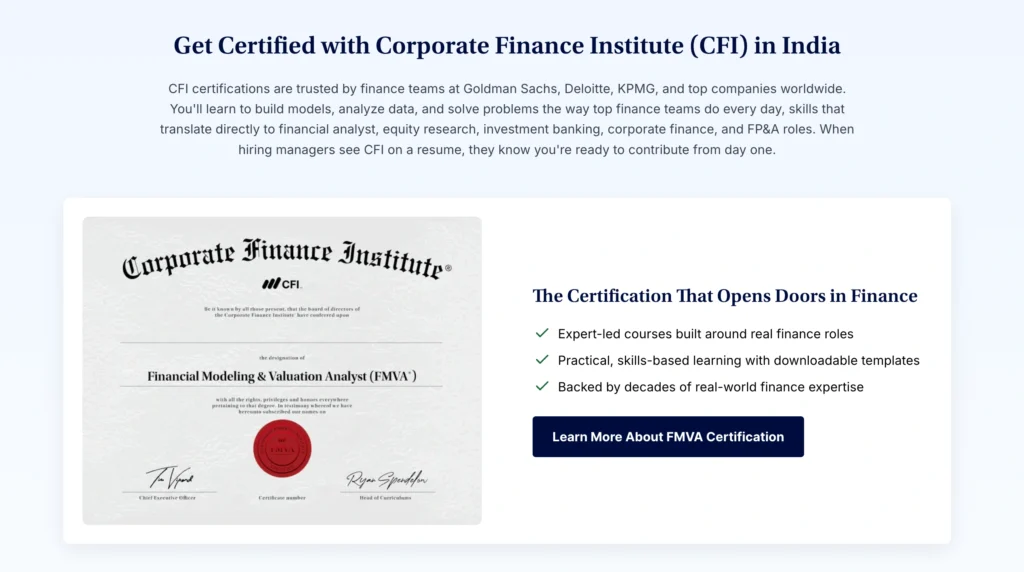
FMVA for Financial Modeling and Valuation
FMVA is the strongest CFI choice for aspiring financial analysts, investment banking candidates, corporate development professionals, equity research associates, and FP&A teams that need better financial modeling skills. CFI’s current program guide lists 14 core courses and requires at least three electives before the final exam. The platform estimates 100 to 120 hours to complete it.
The program begins with the foundations but progresses into serious spreadsheet work. You learn to link the income statement, balance sheet, and cash flow statement, forecast operating assumptions, build valuation models, and explain the business drivers behind a model. Formal finance prerequisites are not required, but CFI recommends Excel 2016 or newer, a computer, and internet access.
FPAP for Financial Planning and Analysis
FPAP suits finance professionals who work inside a business rather than on transactions. It focuses on planning cycles, budgets, forecasts, variance analysis, financial performance, and turning numbers into useful recommendations. It is a good match for financial analysts aiming to step up into senior analyst or FP&A manager work.
CBCA for Credit and Commercial Banking
CBCA is relevant for credit analysts, loan officers, private lenders, and risk professionals. It covers credit analysis, loan structuring, security, pricing, financial modeling, and qualitative business analysis. FMVA asks, “What is this company worth?” CBCA asks, “Can this business repay the loan, and how should the lender structure the deal?”
CMSA, BIDA, FPWMP, and FTIP
CMSA fits capital markets, asset management, hedge fund, and wealth related roles. BIDA is useful for finance professionals who want to use Power BI, SQL, Tableau, Python, and dashboards. FPWMP serves financial planners and private banking professionals, while FTIP covers financial technology, blockchain, cryptocurrency, data science, payments, and related subjects.
CFI Pricing: Exact Plans and What You Get
CFI provides two paid plans for individual learners. Both are billed annually. There is no normal monthly or quarterly payment option, and CFI does not allow you to buy only FMVA or one standalone course.
At the time this review was written, CFI listed a 20 percent offer on the regular annual prices. The figures below may change if CFI changes its promotion or taxes apply at checkout.
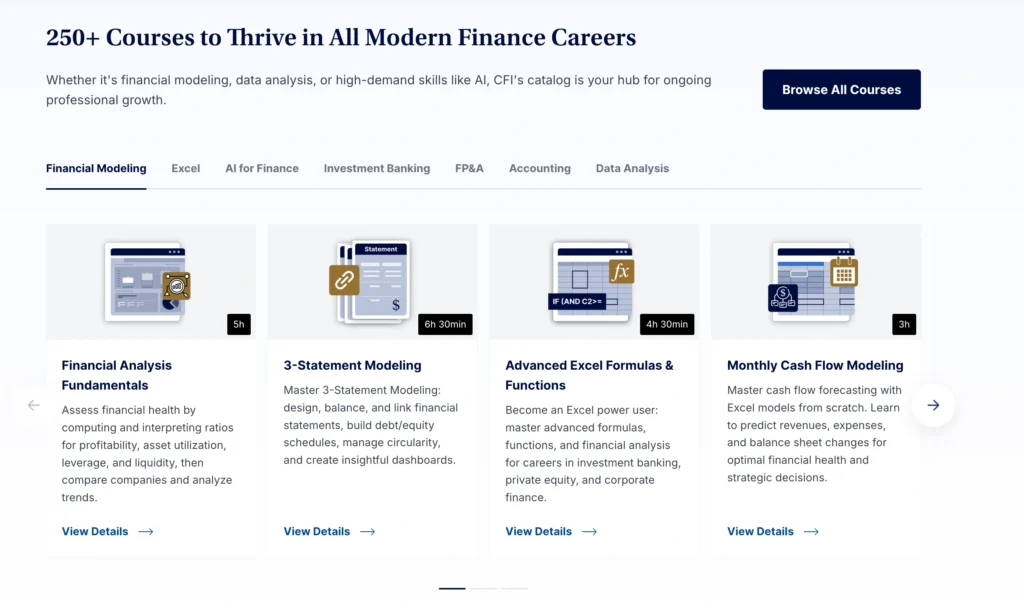
Both plans advertise access to more than 250 courses, seven accredited certification exams, 17 skill focused specialization programs, more than 550 CPE or CPD credits, captions in multiple languages, quizzes, assessments, case studies, and the CFI app. CFI’s current certificate catalog displays 15 specialization pages, so it is sensible to check the live course list when one specific subject is your deciding factor.
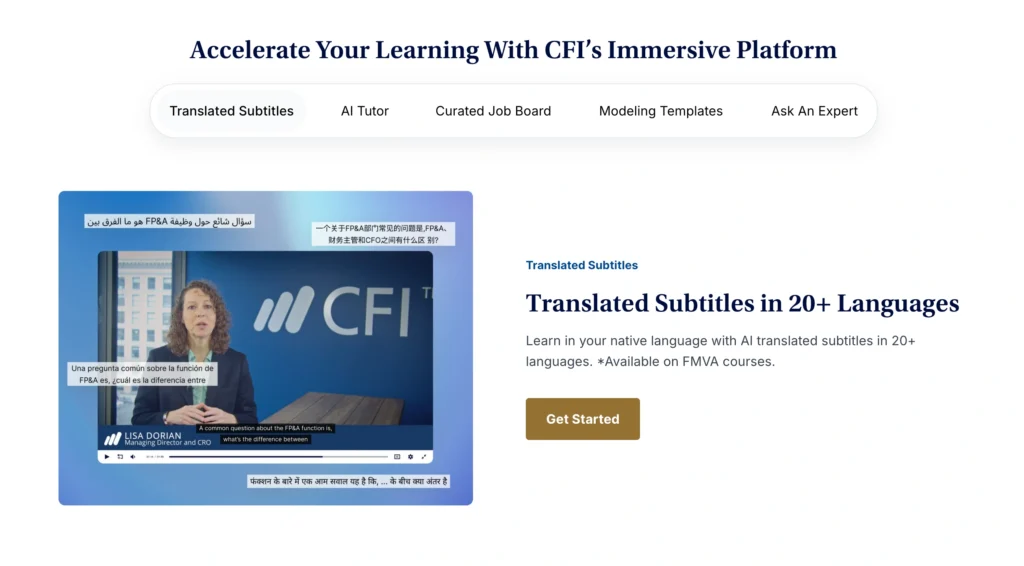
Full Immersion gives more than library access. CFI says it includes a course integrated AI assistant in more than 25 languages, up to five Ask an Expert sessions each week, one model review each week, premium templates, and partner offers. It is useful for learners who want feedback. For most self disciplined users, Self Study will be enough.
CFI Student Pricing
Eligible university students can receive a 50 percent discount. CFI’s student page showed Self Study at $248.50 per year and Full Immersion at $423.50 per year. Eligible accounts include .edu and similar university domains, .ac.uk, and many Canadian university domains. CFI states that the student rate renews at 50 percent off until cancellation.
Billing and Refunds
CFI subscriptions renew automatically each year unless you disable automatic renewal in your billing settings. CFI’s published policy says payments are generally nonrefundable, although eligible European Union customers have a 14 day refund right under local law. Disable automatic renewal soon after purchase if you plan to use CFI for only one year.
CFI Features: Detailed Breakdown
The feature set is one of CFI’s best points. A learner can start with accounting and Excel, earn FMVA, add an FP&A specialization, and study BIDA courses for dashboards and data skills. That is a useful mix for modern corporate finance roles where reporting, models, and data analysis are increasingly connected.
How CFI Exams and Certificates Work
CFI certificates require more than watching videos. You need to complete program requirements, which may include core courses, electives, case studies, and qualified assessments. Every certificate program includes a practice exam and a final exam.
Final exams are taken online at your convenience but are timed and cannot be paused after you begin. Questions are randomized multiple choice questions, and the passing mark is 70 percent. For FMVA, CFI says learners need 80 percent on each end of course assessment to qualify for the final exam. Failed final exams can be retaken without an extra fee while your subscription is active, but there is a 30 day waiting period. After you pass, CFI provides a blockchain verified digital credential.
This is more valuable than a simple completion badge because it requires a learning standard. Still, no online certificate can replace actual work experience, a degree requirement, or a regulated professional license. The best result comes from combining the certificate with strong Excel projects, internships, and confident interview answers.
Course Quality and Learning Experience
CFI’s lessons are structured in manageable sections, which helps beginners build confidence before reaching advanced modeling exercises. The platform is easier to follow than trying to learn from random finance videos, because the curriculum tells you what to study first and which skills build on each other.
The course quality depends heavily on your study method. Do not only watch the videos. Download every workbook, rebuild models without looking at the answer file, correct your errors, and keep the best completed models in a personal portfolio. Templates are helpful, but only when you understand why the formulas and structure work.
FMVA is especially useful for people who want a clear financial modeling path. It connects accounting, assumptions, forecasting, scenario work, valuation, and final outputs rather than treating them as unrelated topics.
CFI Pros and Cons
Pros
• Broad finance library instead of one isolated modeling course
• Seven certificate paths under one membership
• Strong coverage of modeling, valuation, FP&A, credit, capital markets, and data analysis
• Flexible self paced schedule for students and working professionals
• Templates, case studies, practice exams, and downloadable learning materials
• Student pricing offers significant value for eligible learners
• Full Immersion provides useful support for difficult models
Cons
• Annual subscription is not ideal when you only need one course
• No monthly plan or standalone certificate purchase
• Learning access ends after the subscription period unless you renew
• Payments are usually nonrefundable
• Full Immersion costs much more and is not needed by every learner
• The certificate helps a resume but does not replace real work experience
CFI vs Similar Finance Training Products
Wall Street Prep’s Premium Package lists seven courses and just under 46 hours of content for $499. It has a tighter focus on financial statement modeling, discounted cash flow valuation, comparable companies, mergers and acquisitions, and leveraged buyouts. Breaking Into Wall Street’s Platinum plan gives access to its wider library for one year and does not renew automatically.
CFI vs Wall Street Prep
CFI is better value for people who want breadth. One membership gives you financial modeling, FP&A, data analytics, credit, capital markets, wealth management, and FinTech. This is useful for someone still deciding where to build a finance career.
Wall Street Prep makes more sense for someone who only wants concentrated technical training for investment banking, valuation, mergers and acquisitions, and leveraged buyouts, with lifetime access. Its Premium Package costs $499, while CFI Self Study has an ongoing annual access model.
CFI vs Breaking Into Wall Street
CFI is the stronger choice for a wider corporate finance career because you can move between FMVA, FPAP, BIDA, CBCA, and CMSA. Breaking Into Wall Street is a better fit for students who need investment banking interview preparation along with models, Excel training, PowerPoint work, networking support, and industry specific case studies.
A key difference is buyer protection. Breaking Into Wall Street offers a 90 day money back guarantee on its one year plans, while CFI’s normal refund policy is much stricter.
Who Should Choose CFI?
CFI is a good choice for finance students preparing for internships, career changers who need a clear learning route, financial analysts improving their modeling, corporate finance and FP&A professionals, credit and banking professionals, and analysts who want to combine finance knowledge with Power BI, SQL, Tableau, Python, and dashboards.
It is not the best fit for someone who only needs one short Excel course, wants permanent access without a renewal, or needs a qualification for a legal licensing requirement. In those situations, a focused one time course or a formal professional qualification may be more suitable.
Is CFI Worth It?
CFI is worth the price when you use the whole membership. The $497 Self Study plan becomes good value if you complete FMVA and then take several additional courses, specializations, or another certificate. It is not good value when you enroll for a single short course and never return.
For most learners, Self Study is the sensible plan. It includes the main certificates, course library, templates, and assessments without the extra price of support features. Full Immersion is best for people who know they will use expert sessions, model feedback, and the AI Tutor.
CFI can help you gain useful finance skills. To get the real benefit, apply each lesson in Excel, build a small portfolio, and learn to explain your work clearly. That is what turns a CFI certificate from a resume line into evidence that you can contribute in a finance role.
CFI Review FAQs
Is CFI FMVA respected by employers?
FMVA is an applied finance certificate that demonstrates financial modeling, valuation, forecasting, and Excel skills. It can strengthen a resume, but it does not guarantee a job by itself.
How much does CFI cost?
The normal annual prices are $497 for Self Study and $847 for Full Immersion. CFI’s pricing page showed a 20 percent offer at the time of this review, with prices of $397.60 and $677.60. Eligible students may get 50 percent off.
Can I buy only FMVA?
No. CFI uses annual memberships and does not sell individual courses or individual programs.
How long does FMVA take?
CFI estimates 100 to 120 hours. You can complete it on a self paced schedule during your active membership.
Does CFI offer monthly payments or refunds?
CFI says memberships are billed annually, not monthly or quarterly. Payments are generally nonrefundable, subject to rights required by law.